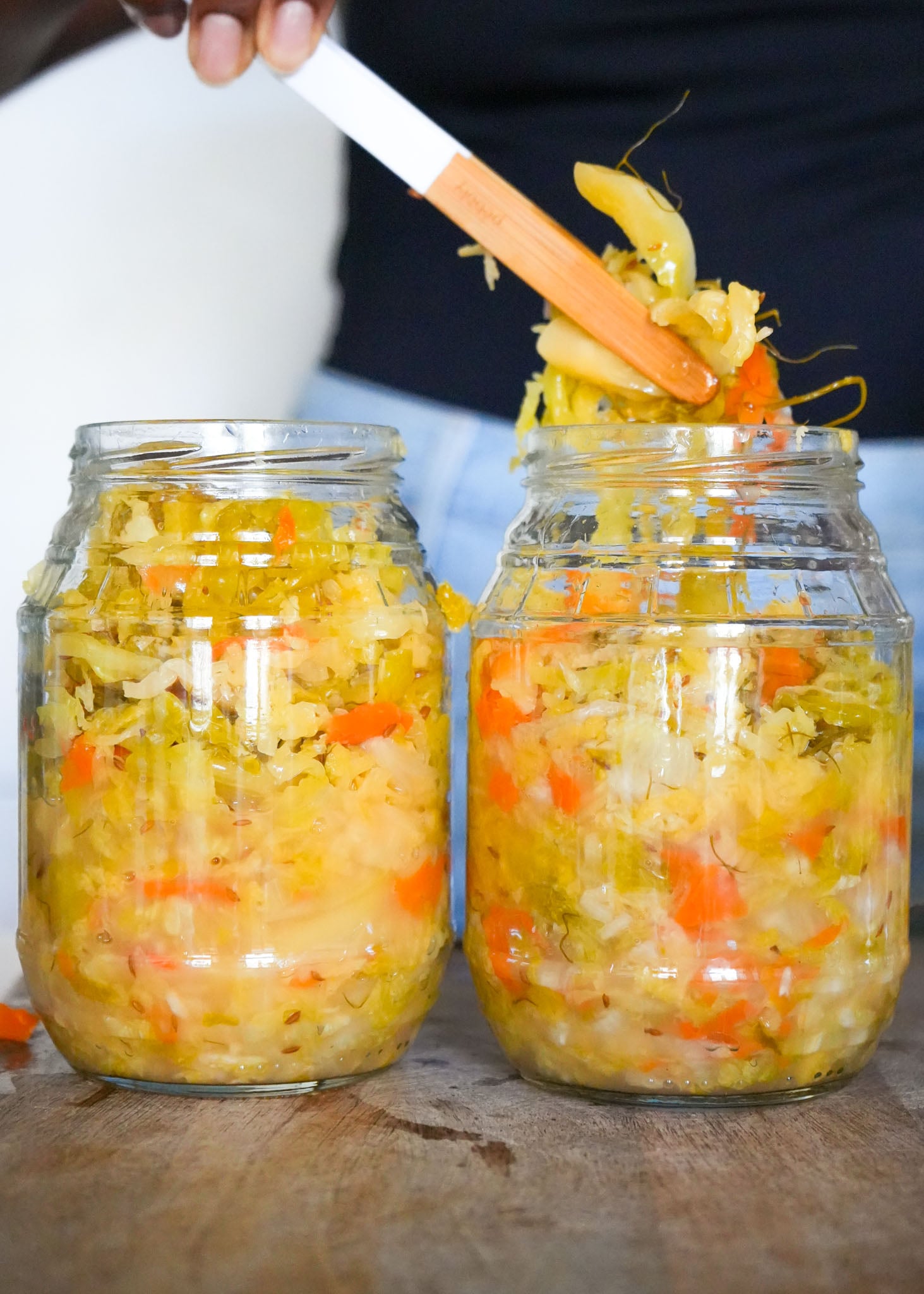
Homemade Sauerkraut (Raw Gut-Friendly Sauerkraut)
All you truly need is cabbage and salt. Here is the ultimate guide to making the best gut-friendly homemade sauerkraut
Print
Pin
Servings: 64 ounce jar
Calories: 15kcal
Ingredients
- 1 Large Head of Cabbage, shredded I use 1060g of shredded cabbage
- 2% or 3% Sea Salt (see notes) (I use 37g sea salt, which is 3% salt percentage) *Remember: Avoid using iodized table salt and any salt containing anti-caking agents or chemical additives.
Optional Flavorings
- 2-3 teaspoons Caraway Seed (gives that traditional German sauerkraut flavor)
- 3 tablespoons Fresh Dill, chopped
- 2-3 Large Carrots (I use 150g shredded carrots)
Instructions
Prep and weigh the vegetables
Remove any damaged outer leaves from the cabbage, then thinly slice the cabbage and carrots. Place a large mixing bowl on a kitchen scale and zero out the scale. Add the shredded cabbage and carrots to the bowl and note the total weight.For my batch, I use: 1060g cabbage, 150g carrots, 1210g vegetables totalCalculate and add the salt
Multiply the total weight of your vegetables by your desired salt percentage.I used a 3% salt ratio, so for 1210g of vegetables, I added about 37g sea salt.Sprinkle the salt over the cabbage and carrots, then massage everything together thoroughly with clean hands until the salt is evenly distributed. At this point, you can either let the mixture sit for about 1 hour to help draw out more moisture, or do what I prefer and cover the bowl with a clean cloth and let it sit overnight, which is what I like to do.Add the flavorings and massage again
When you are ready to jar the sauerkraut, add the optional caraway seeds, fresh dill, or any other spices and flavorings you are using. Massage the mixture again for a good 3 to 5 minutes. You should notice the cabbage becoming softer and releasing even more liquid. That liquid is what will become your natural brine.Pack the jar
Transfer the cabbage mixture into a clean fermentation jar a little at a time.After adding each handful, use a fermentation tamper to press the mixture down firmly. This helps remove trapped air, compacts the vegetables, and encourages even more liquid to rise out of the cabbage. Continue adding and tamping until all of the mixture is packed into the jar. Pour any remaining liquid from the bowl into the jar. By the time you are finished, you want enough natural brine to eventually cover the cabbage. (if you don't see note*)Keep everything submerged
Place a fermentation weight on top of the cabbage and press down firmly so the vegetables sit beneath the brine.If you saved a clean outer cabbage leaf, you can place it over the shredded vegetables before adding the weight to help keep smaller pieces from floating to the surface. Keeping the cabbage submerged in the brine is one of the most important parts of successful fermentation.Add the airlock and ferment
Secure the jar with an airlock lid and place it somewhere out of direct sunlight. A room temperature around 65°F to 75°F works well. Warmer temperatures will speed up fermentation, while cooler temperatures will slow it down.If you are not using an airlock, you will need to burp the jar regularly during week one, which is the most active stage of fermentation.Let it ferment, then refrigerate
Let the sauerkraut ferment at room temperature until it reaches the flavor you like. You can begin tasting it around 2 weeks, but I let mine ferment for about 1 month for a deeper, tangier flavor.Once you are happy with the taste, transfer the sauerkraut to the refrigerator. The colder temperature dramatically slows the fermentation process and helps preserve the flavor and texture you have developed.
Video
Notes
*Not Enough Brine? Don’t panic if the cabbage doesn’t immediately release enough liquid to cover itself. If the cabbage is not completely submerged, make a small amount of 2–3% saltwater brine (20–30g salt per 1 liter of water) and add just enough to cover the cabbage. Avoid adding plain water, which can dilute the salt concentration of your ferment.
How Much Salt Should I Use for Sauerkraut?
The most reliable way to measure salt is by weight. A 2–3% salt ratio works well for sauerkraut, meaning you'll use 20–30 grams of salt for every 1,000 grams (1 kg) of vegetables. I personally use 3% because I like the results, especially for longer ferments. Temperature also matters. Sauerkraut ferments faster in a warm kitchen and more slowly in a cool one. I recommend keeping your ferment around 65–75°F (18–24°C) when possible rather than trying to compensate for very warm temperatures by simply adding more salt. Quick formula:Weight of vegetables × 0.03 = grams of salt
So, 1,000g cabbage × 0.03 = 30g salt.
No Scale? Use This Simple Salt Guide
A kitchen scale is the most accurate way to make sauerkraut, but you can still make a great batch without one. A good rule of thumb is about 1½–2 teaspoons of fine sea salt per pound (450g) of cabbage, depending on how salty you like your sauerkraut. For an easy visual guide:- Small cabbage (about 2 lb): 1–1½ tablespoons salt
- Medium cabbage (about 3 lb): 1½–2 tablespoons salt
- Large cabbage (about 4 lb): 2–2½ tablespoons salt
Nutrition
Serving: 3tablespoons | Calories: 15kcal | Carbohydrates: 3g | Protein: 1g | Sodium: 300mg | Potassium: 120mg | Fiber: 2g | Sugar: 1g | Calcium: 20mg | Iron: 1mg